by Henry Lowendorf, contributor to People’s World
The PAR newsletter committee is greatly saddened to inform our readers of the passing of Al Marder. Al was a member of the PAR community from its inception over thirty years ago. He was active in dozens of peace and justice organizations and instrumental in the founding of many New Haven groups. Our deepest condolences to his family, friends, and all who worked with him.

Al Marder, in his capacity as Amistad Committee President, welcoming the president of Sierra Leone to New Haven City Hall in 2019. Thomas Breen Photo.
Al Marder, a stalwart of the U.S. peace movement and prominent figure in the Communist Party USA, passed away Dec. 19, 2023, at the age of 101. In some ways, the story of his life reads like a serial thriller, with plenty of comedy and tragedy, victories and defeats.
As a teenager, he would sneak out of his parents’ house in a working-class neighborhood of New Haven, early in the morning to meet his good friend Sid Taylor, pushing the family car down the road before starting it so as not to waken his parents. They would distribute fliers and Daily Worker newspapers to workers arriving and leaving plant gates at Sargent and Co. … Years later, his mother revealed that his parents were in fact aware of his goings-on….
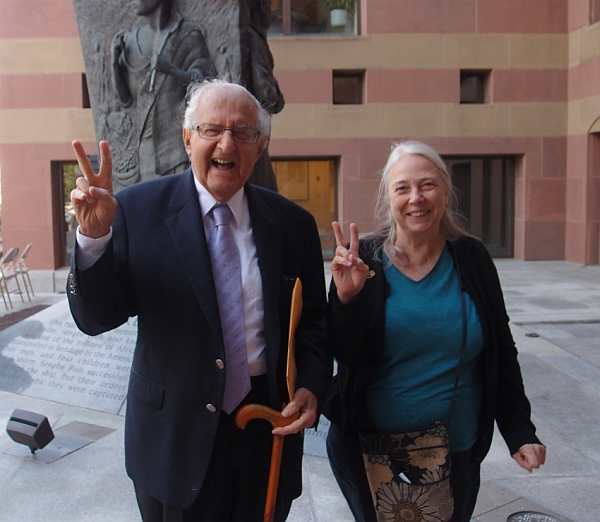
Al Marder poses with New Haven peace activist and Peace Council member Mary Compton at the Peace Day celebration at the Amistad Memorial statue outside New Haven City Hall Sept. 21, 2015. The statue was built thanks to his guidance and supervision. Marder is chairman of the Amistad Committee.
(photo: cjzurcher)
Al Marder entered the fight for justice and peace when he was 14 years old, the height of the Great Depression. He saw families being evicted, his own included, and he saw Communists moving their furniture back into tenants’ houses. He wasn’t alone. The nation was demanding peace. Workers were struggling for their rights and moving unionization to the fore. Peace, he said, was a central demand of the Communist Party in the 1930s.
He became an organizer for the Young Communist League (YCL), becoming a leader in the group at age 16. Al began to connect the anti-Semitism that his family, Jewish immigrants from Ukraine, experienced with the prevalent anti-Black racism. He found that Communists modeled equal treatment of everyone.
At the New Haven Peoples Center, Al found his milieu. The community center had been bought by immigrant, socialist-oriented Jewish tradesmen for their own families and the broader community. … Eventually, Al would become the president of the non-profit that runs the Peoples Center….
After the war, the U.S. turned its big guns on its former ally, the Soviet Union, and with McCarthyism, attacked the progressive movements at home. In 1954, one of eight charged in the Smith Act witch hunts in Connecticut for thinking communist thoughts, Al had to leave his family and go underground. Eventually caught, he was tried and acquitted, but not without serious consequences to many lives.
In the 1970s and ’80s, Al became a leader in the peace movement as the president of the U.S. Peace Council and vice president of the World Peace Council, positions he actively held until the end of his life.
A prime organizer of the anti-apartheid struggle in Connecticut, Marder helped create and lead the City of New Haven Peace Commission in 1988 and the years that followed….
The Peace Commission introduced resolutions into the New Haven City Council, the Board of Alders, calling for abolition of nuclear weapons and moving money from war spending to human needs. On three occasions, the resolutions became ballot initiatives that won overwhelming approval from the city’s voters.
As a result of these activities, New Haven was invited to join the U.N.-sponsored International Association of Peace Messenger Cities, of which Al Marder was president for 12 years, the only non-mayor to hold that position.
Urged in 1987 by African American school board president, minister, and friend Rev. Edwin Edmonds, Al founded the Connecticut Amistad Committee, Inc., in the spirit of the original 1839 Amistad Committee, the first integrated abolitionist organization….
With his amazing memory, wry sense of humor, and easy laugh, Al was known to all as a great storyteller, attending to detail and drawing basic lessons. He shared many of those lessons with those who knew him—lessons they will carry with them forever.
A memorial service will take place at Beaverdale Memorial Park, 90 Pine Rock Ave., on Saturday, Jan. 6 at 9:30 a.m. The family asks that, in lieu of flowers, donations be made to one of these causes: Hospice Foundation of America, hospicefoundation.org/Donate; Jewish Voice for Peace, jewishvoiceforpeace.org; and US Peace Council, uspeacecouncil.org.
[Read the full article online from People’s World: www.peoplesworld.org/article/remembering-al-marder-a-century-of-struggle-for-peace-justice-and-socialism/]
[Read an article by Paul Bass for the New Haven Independent and the Marder family’s obituary: www.newhavenindependent.org/article/al_marder_crusading_true_believer_to_the_end_dies_at_101]